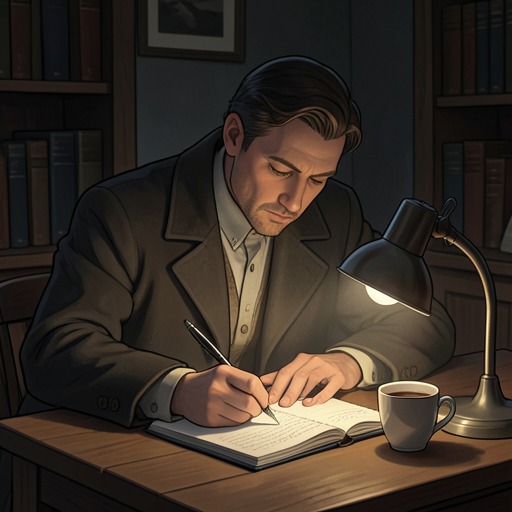
Hemingway resumes writing after the manuscript loss
A Moveable FeastHemingway’s return to writing after the manuscript theft was not a simple recovery of lost work but a new beginning shaped by loss. He first told Edward O’Brien that he would write stories again to comfort him; later, he recalled that at Cortina d’Ampezzo he had in fact completed a story after losing everything. That story, “Out of Season,” became an early test of a method in which omission could do part of the storytelling.
The loss and the promise to begin again
The theft took the novel Hemingway had written, along with other manuscripts: Hadley Richardson had packed originals, typescripts, and carbons into manila folders. In the account’s surrounding details, the loss is not quite total. One story had been in the mail because Lincoln Steffens had sent it to an editor, and “Up in Michigan,” which Gertrude Stein had called inaccrochable, had never been copied and remained in a drawer. Those survivals sharpen the scale of what was gone without undoing the loss of the larger body of work.
After Lausanne, while in Italy, Hemingway showed O’Brien a racing story. He presented it almost as a remnant from a wreck, but O’Brien was more visibly hurt by the loss than Hemingway appeared to be. Hemingway tried to console him, drawing on Chink’s lesson never to discuss casualties: he said the loss might be good for him and promised to start writing stories again. As he reassured O’Brien, he recognized that the promise was true, even though he had made it chiefly to spare his friend’s feelings.
“Out of Season” and the return to work
Hemingway later placed the first story he managed to write after the loss at Cortina d’Ampezzo. He had returned there to join Hadley after spring skiing, which he had interrupted for a newspaper assignment in the Rhineland and the Ruhr. The story was “Out of Season,” a simple piece whose decisive action Hemingway chose not to state outright: its old man’s actual ending was suicide by hanging, but he left that ending out.
The distinction matters. The omission was not an accidental gap or a consequence of the missing manuscripts; Hemingway says he knew what he had removed. He believed that if the writer understood the omission, the absence could strengthen the story and make readers feel more than they consciously understood. The lost work had forced a restart, but the new story turned that restart into an experiment in control: what was left unwritten could carry weight.
From story to longer work
At Lipp’s, recalling the story, Hemingway considered the possibility that readers did not understand the work he was making and that there might be little demand for it. He nevertheless compared that delayed understanding to the reception of painting: time and confidence, he thought, were what mattered. His confidence had a material edge. He reflected that cutting down on food required self-management to prevent hunger from taking over his thoughts, and treated hunger as a discipline from which a writer could learn.
The loss also left a larger task waiting. Hemingway believed he must write a novel, but felt that he had been struggling to make paragraphs distill the substance of a novel. He resolved to build toward it by writing longer stories, as a runner trains for a longer race, rather than begin the novel simply because it was necessary to earn enough to eat regularly. He would wait until writing it became unavoidable. The first story after the theft thus belongs to a gradual reconstruction: not the recovery of the stolen novel, but a return through shorter work, deliberate omission, and a decision to let pressure accumulate before attempting a book-length form.
Significance
The episode links material deprivation to artistic method without treating the loss as a gift. Hemingway calls it probably a good thing to have lost his early work, yet the theft remains the condition that interrupts his writing and makes the restart necessary. “Out of Season” gives that restart a formal consequence: Hemingway moves from the vanished manuscript toward a practice in which absence itself can shape a reader’s response. His resumption is therefore both practical and compositional—a return to writing, and a changed understanding of what a story need not say.